How Lana Del Rey’s “Norman Fu**ing Rockwell” Deconstructs Americana

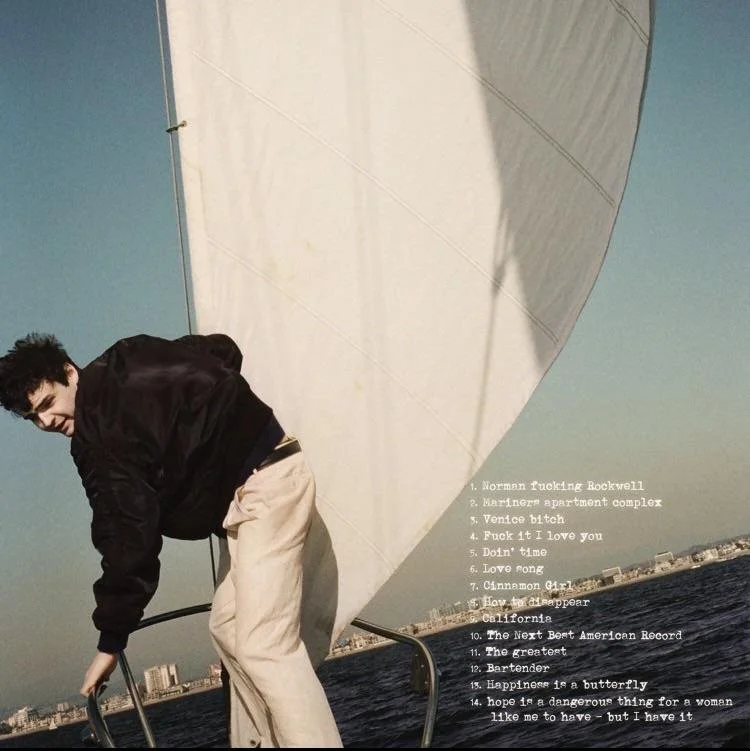
Album cover of Lana Del Rey’s “Norman F***ing Rockwell” depicting the artist on a sailing boat, Courtesy of Interscope Records and Polydoor Records
Often credited to post-WWII artist Norman Rockwell, the visual identity of the American Dream—joyful family dinners, houses with white-picket fences, and the belief that hard work guarantees success—worked in tandem with mid-century optimism. But that promise was short-lived. Today, with over 51% of Americans finding the Dream economically unachievable, Lana Del Rey uses her 2019 album Norman F***ing Rockwell! to navigate the sorrowful loss of this ideal. Interrogating patriarchal structures, capitalistic decay, and environmental precarity, Del Rey transforms Rockwell into a conceptual vehicle to unravel America’s broken promises.

Norman Rockwell, Freedom from Want, 1942. Oil on canvas. © Norman Rockwell Family Agency. Courtesy of the Norman Rockwell Museum Collection, Stockbridge, Massachusetts.
Personifying a Patriarchy: Outdated Masculinity
Historically, the American Dream relied on a male patriarchal family structure—the male breadwinner as a reliable economic provider. Del Rey critiques this dynamic on the album cover, where her reliance on a male partner for maritime navigation mirrors a woman's traditional reliance on men for financial and personal security. Yet in a post-#MeToo era, this reliance is no longer reflective of 21st-century reality.
In the title track "Norman F***ing Rockwell," the addressee is introduced as both a masculine love affair and a dualistic personification of America. But despite the patriarchy's idealization of male protection, the partner is exposed as deeply insecure:
"Goddamn, man child / You act like a kid even though you stand six foot two"
The six-foot-two frame promises traditional male protection, but "act like a kid" exposes underlying infancy. Like America’s declining ability to hegemonically protect the world, the Rockwellian breadwinner becomes tainted. Later, when his emotional fragility bleeds into the lyrics—"Your head in your hands / As you color me blue"—his denial of vulnerability transfers sorrow directly to his female partner.
In "Mariner’s Apartment Complex," Del Rey flips this dynamic by taking the helm: "You're lost at sea, then I'll command your boat to me again / I'm your man". By declaring she can command a lost boat, she undermines the belief that women are inherently dependent on men. However, stating "I'm your man" reveals a lingering issue: to be seen as competent, her leadership must still be framed through a masculine identity.
The Economics of False Advertising
The erosion of economic security sits at the heart of the Dream's decay. As economist Raj Chetty notes, the share of American children out-earning their parents collapsed from 90% in 1940 to 50% for those born in the 1980s. Track ten, "The Next Best American Record," reflects on the experience of chasing these promises in a society no longer equipped to deliver them:
"And we were so obsessed with writing the next best American record / That we gave all we had ‘til the time we got to bed"
Writing an "American record" represents an achievement nearly impossible to pull off, working in parallel with the Dream’s promise of financial reward for relentless labor. Yet, Del Rey's use of past tense—reflecting on how "obsessed" they were—insinuates a eventual state of quitting the chase. It captures a broader cultural loss of trust in hard work.
Norman F***ing Rockwell Tracklist, Courtesy of Polydoor Records and Interscope Records
What has decayed is not just material security, but the emotional reward of faith in the Dream itself. Even during nostalgic escapes, reality quickly breaks through: "I see you for who you really are / Why the thousands of girls love / The way Bill plays guitar". Lana reminds us that America’s melodic allure is often a hypnosis engineered to mask unkept promises.
The Immortality of Dreams
Ultimately, Norman F*ing Rockwell! does not end in pure defeat. In the final track, "hope is a dangerous thing for a woman like me to have - but I have it," Del Rey contrasts the hollow nature of elite success ("debutantes... on white yachts") with her own complicated past. Even after recognizing the structural failures of patriarchy, capital, and climate, holding onto hope becomes an act of quiet defiance—redefining the Dream to survive the 21st century.