Analyzing City Pop in Japan, and How It's Been Glamorized in Today's Social Media
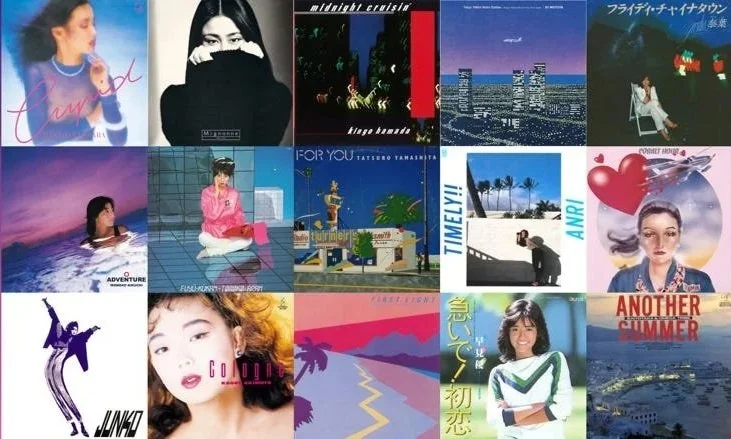
An Image of Some of The Most Defining City Pop Albums and Singles, Credit: Goosebump Radio
There is music that always arrives the way a memory does. It doesn’t crash loudly, doesn’t arrive with a PSA, but tenderly arises somewhere in the backdrop of your daily life, somewhat like an afterthought. Today, that mysterious musical presence has emerged from TikTok in a method that feels natural and nonchalant with the surprising phoenix-shredings of social media’s “cringey” hyper-fixation culture on algorithms. It’s always there. Perhaps amongst the millions of videos you may or may not find on YouTube, rabbit hole off a title on the likes of "tokyo midnight vibes" or “Japanese music.” A presence that hides under the surface, yet comes to life when you feel least expectant of it.
Of many genres that can mix such fascinating qualities, one is the City Pop music style born in the midst of Japan’s 70s and 80s, economically known as the golden age of this Asian Tiger. It’s often characterized by warm basslines, glassy synths, the distinct feeling of summer fading away as you drive from the beach to home for the last time, and the occasional saxophone in the background. Somehow, nearly 50 years after the golden age of this music niche, a new generation has rediscovered the skeletons of this genre and is quite frankly ‘social media obsessed’. It brings up a question, though, not about its resurgence, but about why it always lingered.
What Is City Pop, Exactly?
Before we discuss the modern algorithm (a topic I quite literally hate in my daily life yet keep coming back to in discussions–I guess you tend to find fascination in the things you can’t avoid and feel aware of in the external sense of it affecting others), it’s crucial to explore the acoustic definition of City Pop. In a way, City Pop is a living documentation and testimony of the cause and effect of Japan’s bubble economy era. At the time, Tokyo’s wealth and rapidly embodied cosmopolitan lifestyle came with quick changes. For one, I remember my mom (who was born in the 70s and was raised in Japan) explaining how shocking it was to try Kiwi or Pineapple for the first time as it was newly imported to Japan or the first time a BigMac was orderable in Japan: she vividly shares the long lines to McDonalds or the agape looks of amaze around the dinner table as the fruits were cut open for the first time.
In parallel similarity, City Pop brought a new perspective to the Japanese Music Industry. It felt fresh, breezy, warm, urbanly aristocratic, and possessed the feeling of excitement, novelty, and the embracement of modernization. I mean, think of it–it was only about a century ago that Japanese music was defined by traditional sounds. To go from imperial Edo-jidai music to Western equivalents of music within such a short period is a significant jump. The leaders in this revolutionary change? Tatsuro Yamashita, often called the "King of City Pop," Mariya Takeuchi, Anri, and Miki Matsubara practically defined the genre.
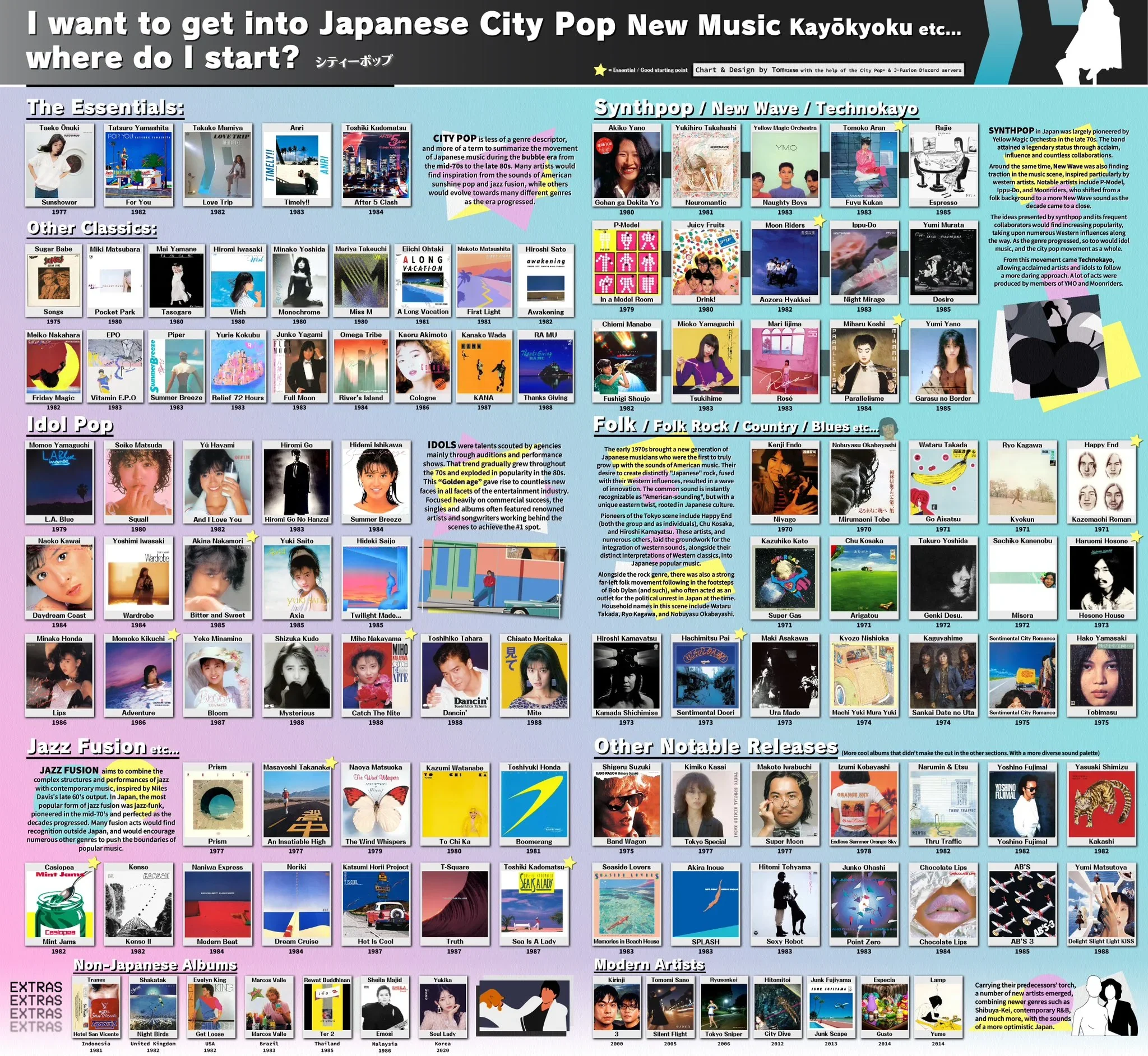
A Guide to Exploring the City Pop’s Wide Genre, Created by Deleted Reddit User via r/CityPop
The Viral Catalyst
So, with all this ancient history, what moment exactly defined a second deep breath for this musical movement? If there's one song that opened the door, fingers point to Mariya Takeuchi's "Plastic Love." The song, released in 1984, had lived quietly in Japan for decades. From around 2017 to 2019, YouTube’s algorithm started picking up on the song and giving it traction of Western listeners. In hindsight, the resurgence was on the likes of a miracle. No one really understood how it started to become recollected by a modern group.
By then at the end of 2019 (as you may or may know), TikTok’s explosively rising popularity started to widen the playing field for musicians, music, and content creators alike. Without much surprise, the tens of millions of streams and slow-burning success of “Plastic Love” started to carry on to TikTok and allowed the City Pop genre to formulate its distinctive brand. Pastel thumbnails, anime characters, or “city pop vibes” to any song, including a warm bassline, became the moment for the genre. While it can’t be said that everyone who started interacting with the genre could decipher the true meaning and beauty of the genre, it’s clear that City Pop slowly but surely became an identity of Japanese music.
Mariya Takeuchi’s Plastic Love was so popular that nearly 40 years since its 1984 release, a music video was created, reaching over 70 million views, Credit: Mariya Takeuchi
Nostalgia in Embodiment: “Remember Summer Days” and “Stay With Me”
Within the City Pop canon, Anri can often be seen as the face. Her visual brand communicates the genre before a single note plays–something that feels like the wind, a slow summer drive with the roof down, a glimmering summer, and a slow-motion walk down places like Venice Beach at sunrise after staying out all night. In Japan, Anri is mainly remembered for “Timely!”, and seeing its success (the 10th most-selling album of her time upon release), it’s unsurprising that “Timely!” was the album that cemented most of her mainstream acclaim. And, from its runtime comes one of her most defining moments: “Remember Summer Days.”
"Remember Summer Days" is perhaps one of the most City Pop-coded tracks in her discography. Yet even then, there is a distance between Anri and the genre she explores. When listening to the track, it feels like the summer is about to end and that with it the sounds of City Pop get dimmer and dimmer. In this song, Anri does not live in the genre. Instead, she longs for it. That tension, between the warmth of the aesthetic and the ache underneath it, is exactly what has poised her (yes, 40 years ago) for being the moment within City Pop.
While trying to stay pragmatic, I’d like to say that what feels subtextual in City Pop revival is that nostalgia is the core component, even more so than just the acoustic similarities between the songs of the genre. The most prevalent songs within the City Pop discography all contemplate the feelings of transition between past and present and express the imagery of fleeting time in a very specific way. “Remember Summer Days”, for example, says this very literally: “Remember Summer Days | 夏が消えていくわ (The summer is starting to fade).” Desperately affirming her love for the summer within her lyrics, the song clearly contemplates the feelings that come with having to let go of something that feels so dear to one.
Similarly, "Stay With Me" by Miki Matsubara isn't a love song. It's a plea. A longing chorus asking someone not to leave, draped in production so warm and shimmering you almost miss how much it hurts. The stain of coffee the lover spilled on your sweater is no longer a silly inconvenience but a painful memory of the past. It’s a present-existing physicality of the past.
Clearly, it’s noticeable that the most defining City Pop songs are centered around absence and the sensation of fading out. The production sounds like arrival, and the emotion underneath is departure. So when one discovers "Stay With Me" late at night and feels something they can't quite name, they aren't misreading the song. When one feels both conceited between the song’s comfort and pained by the song, it only escalates the song’s addictiveness.
A Modern Take and Historical Similarities
Today, maybe the ones who enjoy this genre have a deep subconscious psyche that reacts to the modern world, which comes with many similarities to the past. Consider Gen-Z specifically. As a generation born into technology, raised on social media, and native to a digital world that predecessors could only watch arrive from the outside, Gen-Z, in a very real sense, is a generation that lives in the seam between what was and what's becoming, between a world that felt simpler and one that is accelerating faster than any of us signed up for.
In a familiar sense, City Pop’s origin (Japan's bubble era) also faced a similar origin. Crashing into modernity, familiarity dissolved quickly with a taste of excitement and fear for what’s to come. The music didn't just document that transition; it captured it as if taking a Polaroid. Every light in the photo is a near-accurate but still hazy recollection of that moment.
In 2026, with the world at yet another inflection point (see our plethora of fun: geopolitical instability, the quiet upheaval of AI, an economy that feels like it's running on borrowed confidence, climate change, and still (even nearly a century since Hiroshima and Nagasaki), nuclear bomb fears), it makes sense that the glamorization of City Pop isn't purely aesthetic. It's emotional. It's generational. And it’s a current event.
As City Pop resurges, it’s relevant to consider how our current context has influenced its welcome back to a degree of mainstream world. Even still, the genre exists in corners of the internet, even with all of its viral success just a few years ago at its peak. City Pop is “timely” (I tried to make a pun) because it’s relevant and, in a way, glamorizes Japan’s past for its early predictions of relatability.
While it creates a mutual connection between an older generation of music lovers and today’s generation, the reasons for many City Pop fans feeling connected to the music are subtextual. In a way, the bridging between these two generations is held together by invisible planks. It comes as an empathetic voice in a time of uncertainty. In such, City Pop never predicted Gen-Z. But Gen-Z was always its invisible audience.