From the Vedas to Vinyl: How Sanskrit Chants Continue to Shape Western Music
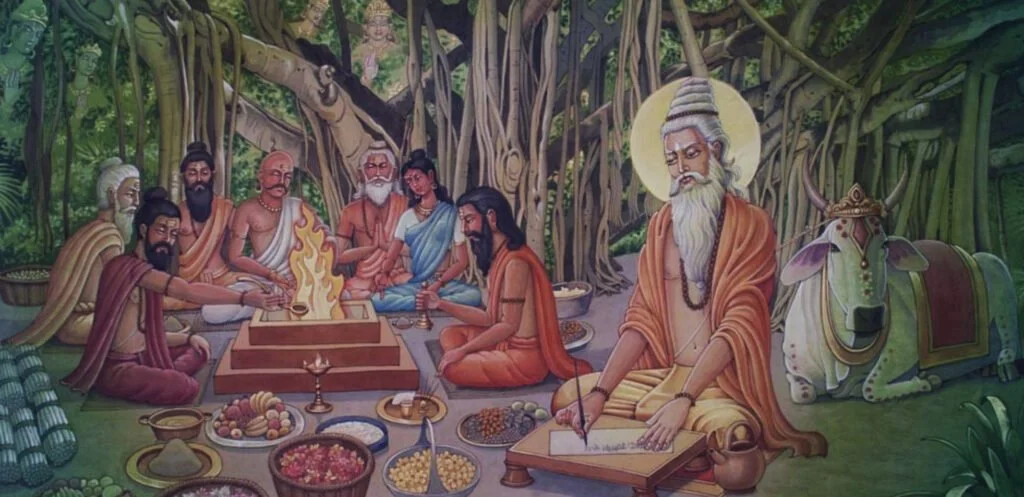
A depiction of ancient Vedic rishis (sages) and disciples gathered in a traditional gurukula setting beneath a banyan tree, illustrating the oral transmission of sacred Sanskrit teachings and mantras. (Artwork courtesy of Himalayan Academy)
When we think of Western pop and rock music, the first things that come to mind are catchy riffs and melodies, references to having a good time, and whatnot, but hidden within the discographies of a surprising number of Western artists, are songs sampling Sanskrit verses composed thousands of years ago as part of an oral tradition to preserve and pass down sacred knowledge across generations. Quite the tonal whiplash if you’d ask me.
Instead of simply listing out artists and their songs that fit the bill, I’d like to discuss the sheer grandeur of the verses. They have been preserved for over 3000 years, and in order to not entertain any inaccuracies, they adopted layered mnemonic systems like Pada, Krama, Jata, and Ghana Patha.
Literary devices like śleṣa and vilomakāvya allowed readers to enjoy 2 stories from one song by the direction they read it from. Imagine if bad bunny wrote a song that when read from beginning to end explored immigration but when read backwards transformed into a patriotic anthem about America. Sounds absurd, I know, but that’s exactly what Sanskrit verses pulled off centuries ago.
The first song I’ll be talking about was composed by a German electronic band, Enigma, titled, The Child in Us, in the year 1996. They took a devotional hymn that had survived for millennia and placed it inside an electronic soundscape, and created this banger of a song that is still loved by listeners all over the world, especially India.
But 1996 wasn’t the first time Western ears were exposed to such Sanskrit hymns. In 1970, George Harrison composed the catchy folk rock song My Sweet Lord, which has an immensely cheeky and heartwarming story. After significant time spent in India, he felt an urge to bridge the gap between Christian gospel and Hindu hymns. In a highly conservative era where religious dogmatism was the norm, Harrison convinced Western listeners, irrespective of their beliefs, to chant hare krishna along with hallelujah.
Let’s dial it back to 1996, the year when Britpop was at an all time high, with working class anthems being sung by the Gallagher brothers and whimsical ironic artsy songs composed by Blur. Their contemporaries, the psychedelic rock band, Kula Shaker, who had the same feelings towards the George Harrison song as me. Frontman Crispian Millis grew fed up with the 1990s drug culture and Britpop lyrical themes and famously said "You can sing about things like premature teenage sex, or you can sing about everlasting, universal truth." Inspired by the Hare Krishna move made by George Harrison a quarter century ago, Kula Shaker made it a lot less subtle and wrote a rock song with just Sanskrit lyrics, and Indian classical instruments playing in the background, and made it so catchy that it reached Number 7 on the UK Singles Chart, making it the only song sung entirely in Sanskrit to ever break into the British Top 10.
These songs were made at least a decade prior to my birth, so how did I gain interest in this quaint genre of music? The answer to that lies in the song Ginseng Strip 2002 released in 2013, the relevance of 2002 still remains a mystery. Fun fact: The rapper, Yung Lean, was born in the year 1996. Yeah, there has to be some divine play here. I heard it on soundcloud back in 2018 and instantly identified the sampled chanting to have belonged to India, but there were ongoing debates going on back then on the origin of the song. It has been revealed now that the chopped sample can be traced back to a Kannada devotional hymn from the 16th century, called Aneyu Karedere. Funnily enough, the voice behind the chants in both Ginseng Strip and The Child in Us is sung by Dr. Bhagya Murthy, a Singaporean Carnatic singer. In Sweden, a 16 year old Yung Gud came across Loop 61, a collection of samples composed by the Japanese electronic producer DE DE MOUSE, showing how many more nationalities can be tied to a single song.
I’d like to travel back in time and let these ancient Hindu composers listen to these songs, especially Ginseng Strip containing modern day poetry like “Bitches come and go, brah, Got my balls licked by a zooey deschanel look-alike”. Yeah, that will surely get a reaction out of them. Then again, I wonder if they'd simply be amazed that their words had travelled this far.